
Best AI agents for ecommerce teams earn their place when they remove repeated production work without inventing product facts. This test looked at the handoff between a product brief, visual asset production, listing preparation, and launch distribution. The aim was not to treat an agent as an autopilot. It was to see which tasks become faster once a team gives one approved source of truth to a workflow.
The practical test used a fictional insulated travel mug called Trail Sip. The brief fixed the product name, color, material cue, scene, and a small text requirement. That makes errors easy to spot: a wrong color, an added product, or unreadable copy would all make an asset harder to use. For the visual steps, the workflow used Alibaba Qwen Image 3.0 Pro on Wiro. The rest of the seven tasks are agent jobs: preserve facts, draft structured content, create variations, route work to review, and keep launch teams on the same brief.
What this ecommerce agent test checked
An ecommerce workflow often breaks after the product team signs off. The same facts must become a product page, marketplace bullets, ad concepts, social captions, and a review queue. Each handoff invites drift. An AI agent can help only if it keeps structured facts separate from creative choices. It should not decide price, claims, inventory, compliance, or final publishing.
The test therefore checked two things. First, could a text-to-image step make a usable catalog-style product visual from a constrained brief? Second, could the surrounding agent workflow turn the same source brief into a controlled sequence of tasks instead of a pile of disconnected prompts? The visual model was chosen because its Wiro documentation supports text generation, optional reference images, 1K or 2K output, ratios, negative prompts, prompt expansion, thinking mode, and seeds. The model maker describes the Qwen Image family as an image-generation model with a focus on complex text rendering and editing; its Hugging Face model card, open-source repository, and Alibaba Cloud documentation were checked before the run.
The 7 smart tasks for ecommerce teams
1. Turn the product brief into locked source facts
Start with approved fields: product name, color, materials, dimensions, approved claims, audience, exclusions, and required review. An agent can format those fields for later steps. It should flag missing facts rather than fill them in. This is the guardrail that keeps a listing, an ad, and an image from telling different stories.
2. Draft a listing structure
The agent can turn the locked facts into a title, short description, feature bullets, and a longer product-page draft. It should mark any statement that needs legal or merchandising approval. That is more useful than asking for generic copy because the reviewer can compare every line with the original brief.
3. Produce a product visual brief
Instead of sending a loose prompt to an image model, the agent can build a visual brief with a product description, background, framing, text limit, forbidden objects, and intended channel. The output below came from that kind of brief. It is a mock product, not a claim about a real Trail Sip item.
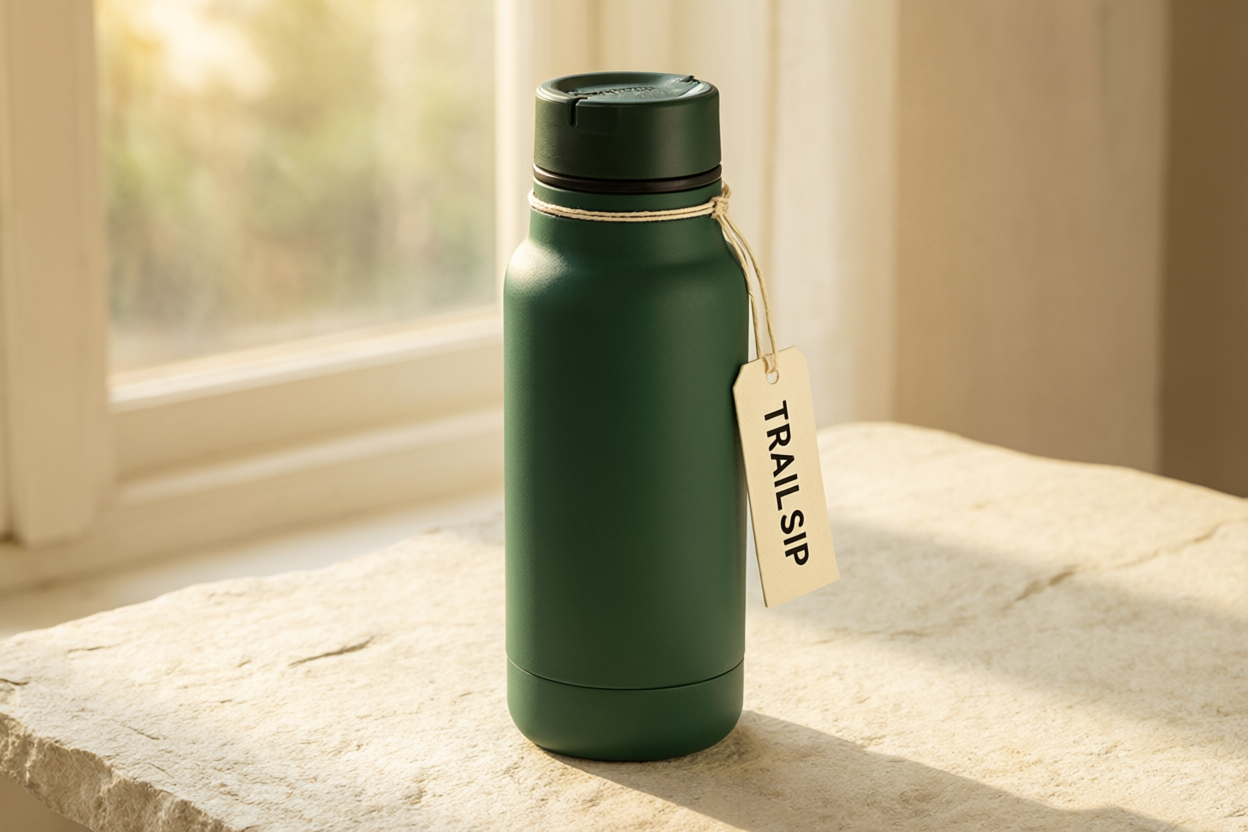
Output 1 checks product isolation and a small text cue. It shows one green mug in a controlled setting, with the requested stone surface and warm light. The result is useful as a concept asset because the product is central and the scene is not crowded. It still needs human review before use: the tag lettering and the product shape must be compared with the approved source, especially if the image represents a real SKU.
4. Make channel variants without changing the brief
The same source facts can drive a marketplace crop, a paid-social concept, and a launch email visual. The agent should change the requested format and channel instructions, not the product claims. This is where a structured workflow helps most. Teams stop retyping the product story for every destination.
5. Test readable text before it reaches a listing
Small text is a hard constraint, not a promise. The second output asked for a simple label reading 18 HOUR HOT. It tests whether the image step can place a limited text element beside the product. The image should be reviewed at the final placement size. If the text is wrong or unclear, replace it in a design tool rather than publish a near miss.

Output 2 shows why an agent needs a review gate. The composition is a clean listing-style frame and it follows the single-product instruction. The requested text is present as a test target, but no generated text should be treated as approved product copy without inspection. This is a good fit for a workflow that routes the asset to a merchandiser or designer with the original claim shown beside it.
6. Create a review packet
An agent can assemble the brief, draft copy, visual prompt, output links, and open questions into one review packet. The reviewer should see what was requested, not only the finished asset. That makes corrections fast and creates an audit trail for regulated claims, product specifications, and brand voice.
7. Hand approved material to launch teams
After approval, an agent can create channel-specific tasks for social, paid media, email, and content teams. It should pass approved facts and final assets forward, not silently regenerate them. Stores that need more distribution support can pair this workflow with related reading on product photography prompts, product-photo editing, and customer winback agents.
Parameters, run time, and cost reporting
Both test outputs used Qwen Image 3.0 Pro with 1K resolution, a 3:2 ratio, one image per run, prompt expansion set to false, thinking mode set to true, explicit negative prompts, and fixed seeds. No input image was used. Fixed seeds make a prompt easier to revisit; they do not guarantee a production-approved result. Thinking mode was left on because the Wiro documentation says it may improve quality while adding latency.
The completed runs returned one PNG each. The completion responses did not expose an elapsed-seconds field or a per-output cost, so this post does not invent either number. Wiro’s model documentation lists the available controls but does not publish a fixed run-time or per-output price for this configuration. For a production test, record the task result, elapsed time, and billed amount from the workspace before setting a service-level expectation. Alibaba’s public documentation lists its own service pricing, which is not a substitute for a Wiro run charge.
When to choose which model and workflow
Choose Qwen Image 3.0 Pro when the ecommerce job needs a constrained product concept, a clean catalog frame, or a text-placement experiment and the team will review every output. Choose a reference-image workflow when product identity must match a real SKU closely; the model accepts up to three input images, but source rights and final accuracy remain the team’s responsibility. Choose a conventional design workflow when tiny legal text, exact packaging, or pixel-perfect brand marks matter.
Choose an agent workflow when the expensive part is repeated coordination: briefs arrive incomplete, channel teams rewrite the same facts, or approvals disappear into chat. Keep humans in control of claims, prices, catalog fields, and final publishing. The best AI agents for ecommerce teams do not replace the product team. They give it a cleaner path from approved facts to reviewed launch work.


Put the workflow to work
See the Ecommerce Listings workflow to turn an approved product brief into a controlled queue of listing and launch tasks.