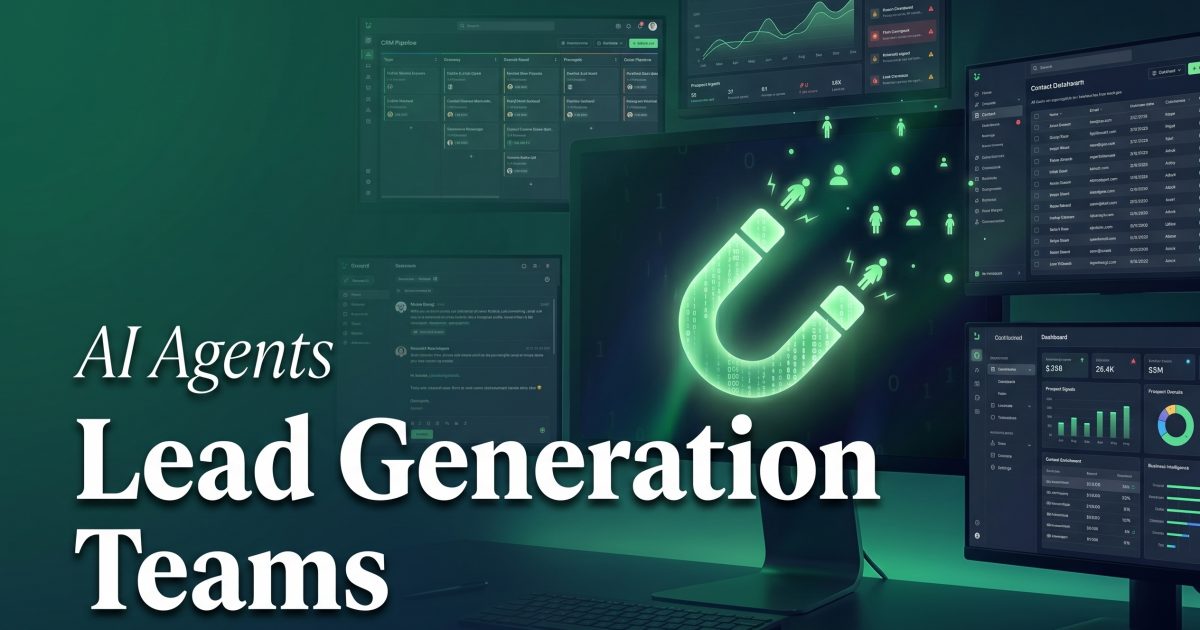
AI agents for lead generation teams help fix the part of pipeline work that usually breaks first: speed after intent. A lead comes in. A prospect list exists. A rep means to follow up. Then the day gets crowded, the record stays incomplete, and the moment goes cold.
That is the real problem. Most teams do not need more names. They need cleaner motion between sourcing, enrichment, outreach, and routing.
That is why this category matters. The best lead gen agent does not stop at one prompt. It keeps the workflow moving until a team has a real next step.
- What AI agents for lead generation teams do
- Where they create the most lift
- How Wiro fits the workflow
- How to choose the right setup
- FAQ
What AI agents for lead generation teams do
AI agents for lead generation teams handle a chain of repeat tasks. They can find prospects, enrich contact details, organize records, draft first-touch outreach, and keep follow-up rules moving after the first interaction.
That matters because lead generation is rarely one isolated job. The work stretches across lists, CRM records, message drafts, meeting handoffs, and reply handling. A simple chatbot cannot cover that well. A spreadsheet cannot either.
Strong lead gen systems reduce delay between those steps. That is what turns a list into pipeline.

Where they create the most lift
The biggest gains usually come from the same few bottlenecks.
- Prospects sit too long before first contact
- CRM records stay partial or stale
- Outreach quality drops because volume is manual
- Inbound leads are captured but not routed well
- Old contacts never get revisited with fresh context
These are boring problems. They are also expensive ones.
A team can hire around them for a while. It can also keep patching them with spreadsheets and reminders. Neither option removes the drag. An agent helps because it works inside the sequence, not outside it.
The Lead Generation Manager is built around that exact motion. Prospect discovery, contact enrichment, and personalized outreach sit in one operating lane instead of in disconnected tools.
Clear operating rules matter here too. The NIST AI Risk Management Framework is a good reminder that once systems touch customer data and outreach logic, boundaries and oversight stop being optional.
How Wiro fits the workflow
Wiro fits this use case because pipeline work needs more than one reply. It needs judgment, sequencing, and follow-through. The platform is built around ask, plan, run, and done, which maps well to sourcing, enrichment, outreach, and recap.
The Anatomy page makes that clearer. Reasoning matters when a record is incomplete. Decomposition matters when one request turns into several tasks. Memory matters when the next step depends on prior outreach or account context.
There is also a practical benefit to using one platform. Lead generation rarely stays inside the CRM. Teams need research, message handling, calendar coordination, and status updates across systems. Wiro’s connected workflow model is more useful than a stack of isolated helpers that never share state.
This also pairs well with the Voice Receptionist for businesses that rely on inbound calls. One agent captures the first touch. Another keeps the follow-up moving after the call is done.

How to choose the right setup
Start with the part of pipeline work that already leaks revenue.
- If leads wait too long, start with first-response speed.
- If records are weak, start with enrichment and cleanup.
- If outreach breaks at scale, start with draft and follow-up rules.
- If inbound is the issue, start with routing and handoff.
The wrong first move is chasing the broadest possible automation. The better move is fixing the one repeated delay that hurts qualification every week.
Wiro works best when a team wants a workflow-first setup, connected tools, editable guardrails, and a clear path from first touch to recap. That is what makes it useful for lean sales teams, B2B marketers, local service teams, and agencies running prospecting at volume.
Related Wiro agents
FAQ
Are AI agents for lead generation teams only for outbound?
No. They also help with inbound routing, CRM updates, and follow-up after the first contact.
Do they replace sales reps?
No. Reps still own conversations and closing. Agents reduce the manual prep and routine follow-up around them.
What is the main benefit?
Faster motion between sourcing, enrichment, outreach, and qualification.
Who sees value first?
Teams with repeated weekly prospecting work and too many manual handoffs usually see it first.
Final CTA
Explore the Lead Generation Manager here: https://wiro.ai/agents/lead-gen-manager