
AI agents vs chatbots is a useful decision only when the team defines the job first. This test checked a simple question: does the work end when the system sends a reply, or must it carry the request into other steps?
The two existing visual outputs in this post make that distinction concrete. They are not a head-to-head model benchmark. No individual Wiro model, prompt, seed, resolution, run time, or run cost was recorded with the original assets. That means no honest per-model performance claim can be made from them. The test here evaluates workflow shape, not image-model quality.
- What the test checked
- What the two outputs show
- Parameters, timing, and cost
- When to choose a chatbot or agent
- FAQ
What the test checked in AI agents vs chatbots
The test separates work into two paths. Path one ends with information: answer a policy question, point someone to a help article, collect a short intake detail, or route a request to a person. Path two continues after the first reply: look up a record, apply rules, write an update, create a task, schedule a follow-up, or escalate an exception.
A chatbot fits the first path. It can accept a question, retrieve approved information, and return a clear answer. That can remove a lot of repetitive support work. It also keeps the system easier to review because the output remains a message.
An agent fits the second path when it has a defined set of tools and boundaries. The model can interpret the request, select an allowed next action, use the connected system, inspect the result, and report completion. The important point is not that an agent talks more naturally. It is that the job has state before and after the conversation.
| Test condition | Chatbot path | Agent path |
|---|---|---|
| Customer asks for return policy | Returns the approved policy | Returns the policy; an action is unnecessary |
| Qualified lead asks for a demo | Captures details or passes the request on | Checks routing rules, creates the record, schedules follow-up, and flags exceptions |
| Support case needs account context | Explains the next step from known information | Reads permitted context, updates the case, and escalates when confidence or permissions fall short |
| Weekly report request | Describes where the report lives | Collects approved data, produces the report, and records the delivery state |
This framing also matches the distinction in Anthropic’s official guide to building effective agents: predefined workflows and systems that dynamically direct tool use are different designs. Neither is automatically better. The smallest design that completes the job is usually the safer choice.
What the existing outputs actually show
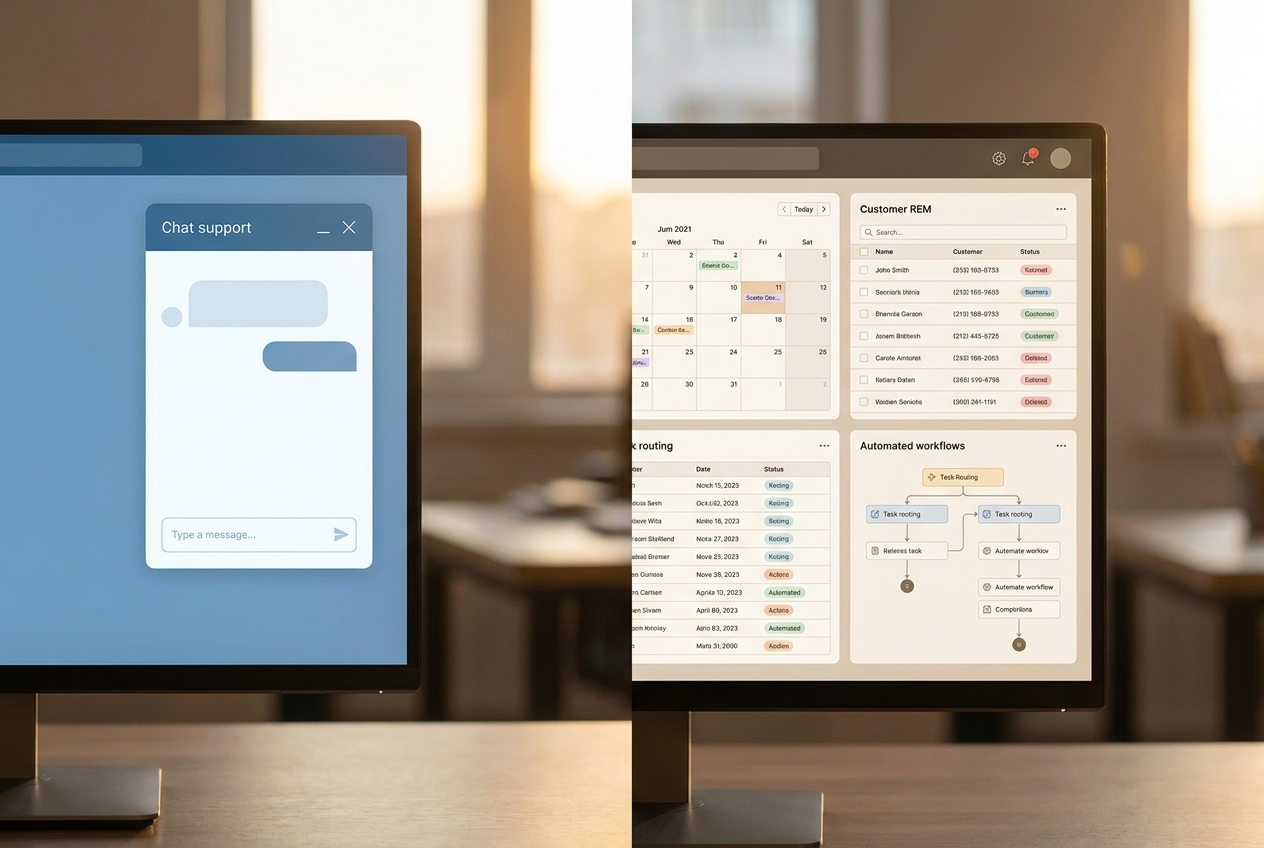
The first output shows the core decision boundary. On one side, a conversation can resolve the request with text. On the other, the request moves through a chain of actions. That is the right visual shorthand for a team deciding whether it needs retrieval and response, or an accountable process that can change records and hand off work.
The output does not prove that an agent will perform every action correctly. It does not show success rates, tool failures, latency, or a safety policy. Those items require a real deployment test with the exact integrations, permissions, and approval rules the team plans to use.

The second output pushes the same comparison one step further. The chatbot stops at the response. The agent path continues into tools and workflow actions. That is useful only if the downstream steps are explicit. A good agent design names which tools it may call, what data it may read or write, which actions need approval, and where it must stop for a human.
For example, a reception workflow may answer opening-hours questions without any system access. Booking a visit needs a calendar check, slot selection, confirmation, and a failure path. A lead workflow may explain a product with no write access, then create a CRM record only after it has collected required fields and passed duplicate checks. Those are separate capabilities and should be tested separately.
Parameters, run time, and cost: what this post can and cannot claim
No original generation parameters are available for either preserved image. The post does not identify a Wiro model, model version, prompt text, negative prompt, aspect ratio, resolution, seed, or inference settings. No run receipt is attached. For that reason, the table below intentionally reports unavailable values rather than guessed numbers.
| Output | Recorded parameters | Wiro run time | Wiro cost | What can be concluded |
|---|---|---|---|---|
| Existing output 1 | Not recorded | Not recorded | Not recorded | It communicates the reply-versus-workflow distinction |
| Existing output 2 | Not recorded | Not recorded | Not recorded | It communicates that actions require connected tools and controls |
There are no Wiro model links in the original post, so there are no model documentation files to read for this update. No new model run was needed because the post already contains two real, blog-hosted outputs. Adding invented settings or synthetic cost figures would make the comparison less useful, not more useful.
For a future measurable test, use the same business task across the candidate designs. Record the prompt or workflow instructions, model and version, enabled tools, permissions, input data, completion criteria, elapsed time, per-run cost, human intervention, and failure reason. Compare the completed task, not just the fluency of the first answer. A fast reply that leaves a record wrong creates more work later.
When to pick a chatbot, workflow, or agent
Pick a chatbot for narrow, answer-first work
Choose a chatbot when the result should be an answer, an approved link, a short form, or a handoff. FAQ support, policy lookup, basic triage, and internal knowledge questions fit this pattern. Keep the source set narrow. Show citations or links when the answer affects a customer decision. Give users a clear path to a person for edge cases.
Pick a predefined workflow when the steps should not vary
Many teams do not need a broadly autonomous agent. They need a fixed workflow with an LLM at one or two points. A form submission can validate fields, apply deterministic routing, draft a summary, and wait for approval before a CRM update. This approach is easier to audit and often reduces latency and cost compared with an open-ended tool loop.
Pick an agent for multi-step work with bounded authority
Use an agent when the next step depends on context and the task cannot be expressed as one fixed path. Good examples include exception-aware intake, research that needs several approved sources, CRM cleanup with review rules, and support triage across multiple systems. Start with read-only tools where possible. Add write access only for specific actions. Set time, cost, and tool-call limits. Capture a trace so someone can see why the agent chose each step.
Related examples on this site show where the workflow approach can help: AI agents for follow-ups, AI agents for appointment booking, and AI agent audit trails.
How Wiro fits workflow-first teams
Wiro is relevant when the task needs more than a response. Its agent anatomy explains the building blocks behind task planning, skills, memory, execution, and recap. Those parts should still be constrained by the business process. A connected tool is not a reason to grant it broad access.
Teams can apply that approach to a Voice Receptionist for intake, a Lead Generation Manager for lead operations, or App Review Support for public-review workflows. In each case, define the allowed actions and the human escalation point before deployment.
FAQ
Are AI agents just advanced chatbots?
No. A chatbot may be part of an agent experience, but an agent adds planning, tool use, state, and completion checks. A fixed workflow with an LLM is another useful middle ground.
Should every business replace chatbots with agents?
No. A chatbot is the better fit when a reliable answer completes the work. Adding tool access to a simple FAQ can add risk without improving the customer outcome.
What should a team measure before choosing?
Measure completion rate, exception rate, human handoffs, elapsed time, cost per completed task, and the quality of record changes. Review failures separately from ordinary questions.
Final takeaway
Choose the smallest system that can finish the real job. Use a chatbot for answers, a fixed workflow for repeatable steps, and an agent when context-driven work must continue across approved tools. Explore Wiro agents at https://wiro.ai/agents/browse.