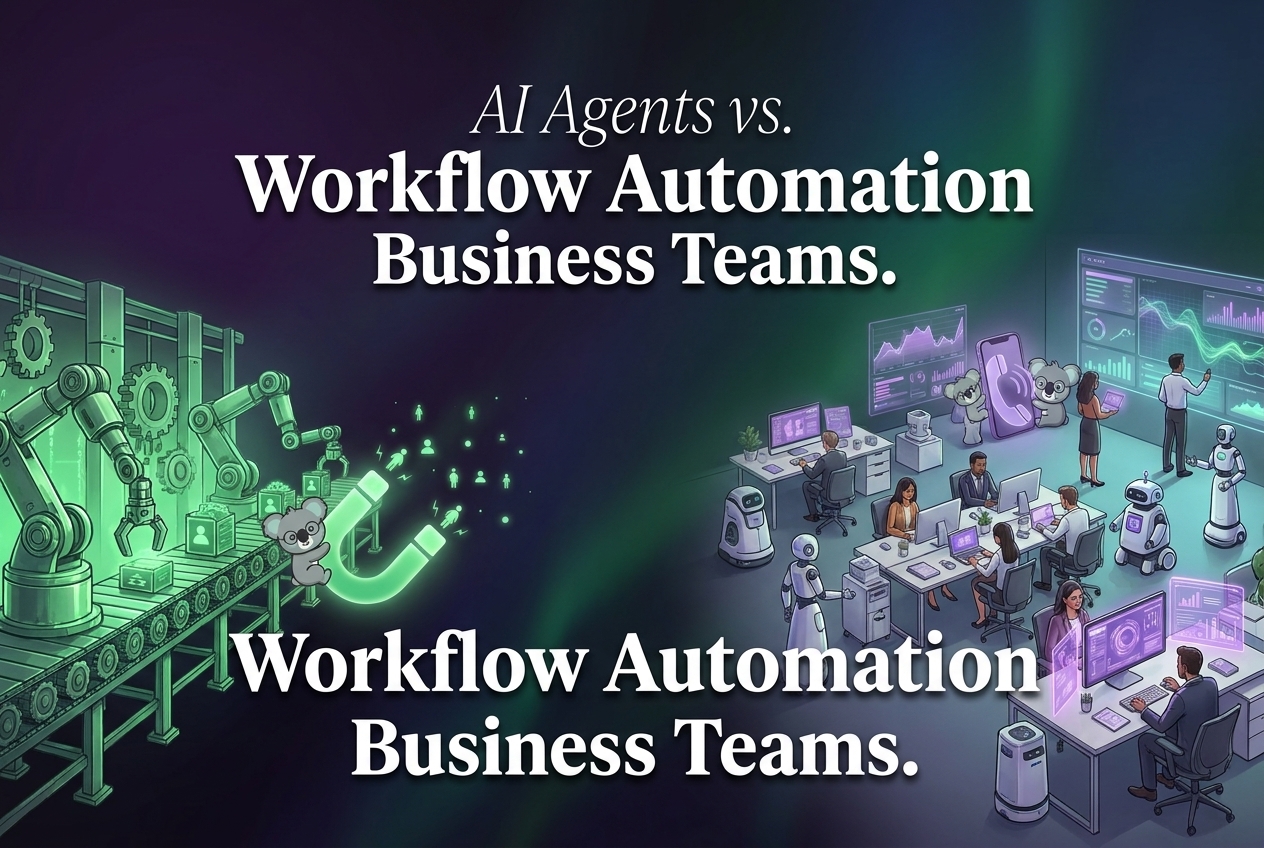
AI agents vs workflow automation comes down to a practical question: does the job have one known route, or must the system interpret what arrives and choose the next step? This article uses two stored Wiro blog outputs to make that distinction visible. It is not a benchmark of named foundation models. No model name, model settings, prompt record, run time, or per-output cost was stored with these two assets, so those figures are not claimed here.
The test set set out to check one business decision: whether a process stays dependable when the input no longer matches the happy path. The two outputs use the same visual language: a fixed sequence on one side and an adaptive route on the other. That makes the contrast useful, even though it does not measure model quality.
- What the test checks
- What the two outputs show
- When to choose workflow automation
- When to choose an AI agent
- How to combine both
- Sources and related reading
AI agents vs workflow automation: what the test checks
The test does not ask whether an agent can replace every automation. That would be the wrong target. It asks what happens after an event arrives with missing, ambiguous, or exception-filled information. A workflow normally moves through a predefined route. An agent can inspect context, call a tool, decide whether a result is sufficient, and either continue or hand the item to a person.
Three operating cases frame the comparison. First, a clean form submission with all required fields. Second, a support request that needs classification before it can be routed. Third, a record that fails a downstream check and needs recovery rather than a dead-end error. These cases describe the intended test set. The published assets are explanatory illustrations of the first and third patterns, not logged screenshots from a live customer system.
That distinction matters. A diagram can show an architecture choice. It cannot prove accuracy, reliability, or return on investment. Teams should measure those on their own data: completion rate, exception rate, handoff quality, time to resolution, and the cost of reviewed mistakes.
Parameters that are actually available
The available asset records give only file-level parameters. Both are JPEG images at 1264 by 848 pixels. The first file is 595,079 bytes; the second is 568,640 bytes. Their records do not include a model identifier, prompt, seed, aspect-ratio setting, generation duration, or Wiro run price. There is no honest way to reconstruct those values after the fact. A future repeatable visual test should save the exact prompt, model route, input files, parameters, run duration, and displayed run cost beside each output.
Reading the two outputs

The first output shows the core split clearly. The fixed lane implies a process whose next action is already known: new lead, validate fields, create CRM record, send notification. This is where workflow automation shines. It is easy to inspect, cheap to run in operational terms, and predictable when inputs follow the contract.
The adaptive lane represents a different job. The system may need to read unstructured text, identify missing information, search an approved source, decide whether confidence is high enough, and write a recap. That is agent work. The image does not show a model reasoning trace or a measured success rate, so it should not be read as evidence that an agent will recover correctly. It shows why the system needs a decision point that a static route does not contain.
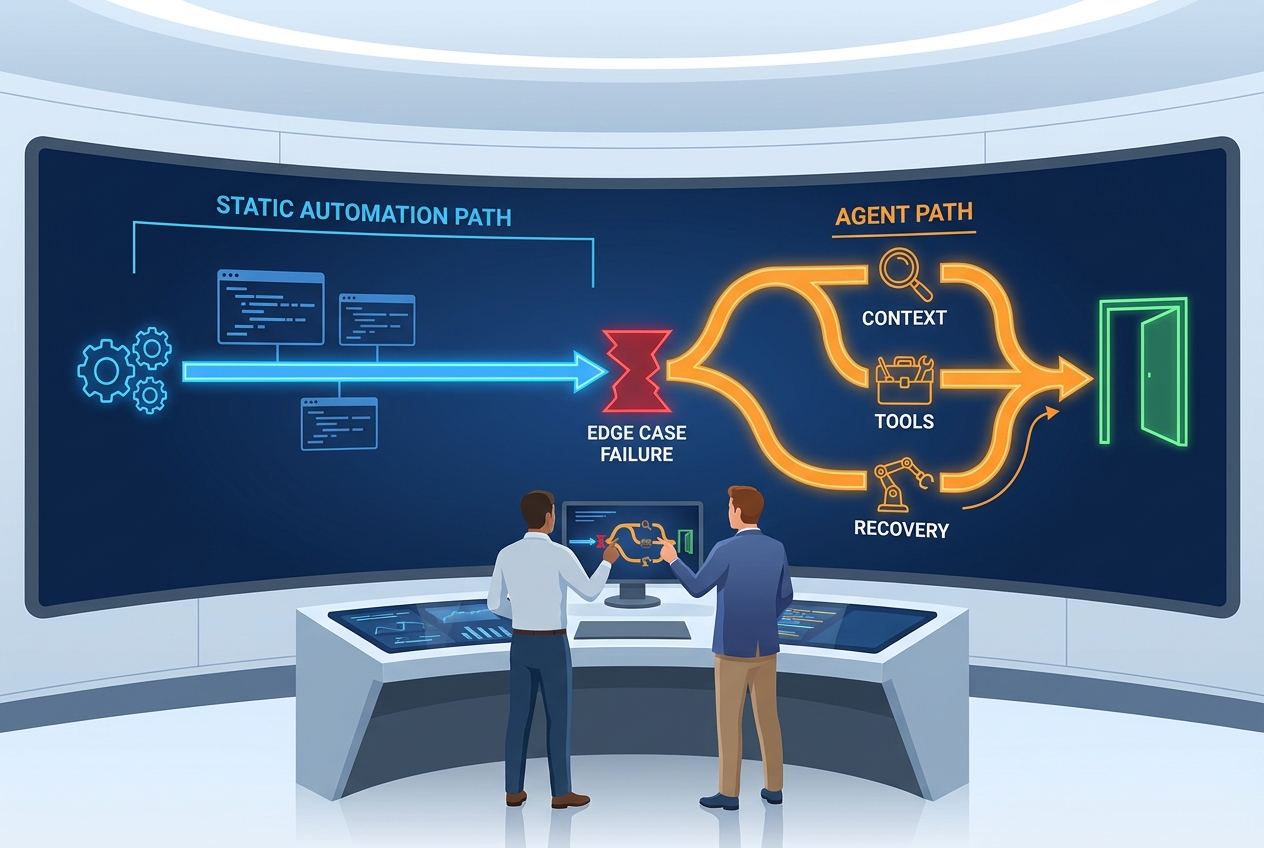
The second output focuses on failure handling. A fixed workflow can stop safely when a required field is absent or an API rejects a record. That is often the right result. An agent can add a controlled recovery path: ask for clarification, look up an approved reference, retry with corrected data, or escalate with a summary. The useful word is controlled. Recovery without limits can turn a small data issue into repeated calls, unwanted changes, or an unhelpful customer response.
When to choose workflow automation
Choose workflow automation when the business rule is stable and the inputs are structured. Field mapping, scheduled exports, status-change alerts, deterministic approvals, and one-way notifications fit this model. A team should be able to draw the full route before it builds it. If each branch can be stated as a rule and exceptions should stop for human review, keep it simple.
Workflow automation also wins when auditability matters more than interpretation. A finance handoff may require exact validation, an immutable approval chain, and no guesswork. Adding an agent there can create risk without removing a real bottleneck. Start with a fixed rule, clear ownership, and a visible failure state.
When to choose an AI agent
Choose an AI agent when the input needs interpretation and the valid next action depends on that interpretation. Examples include classifying support requests, preparing a lead brief from several sources, routing a call based on intent, or drafting a response that must follow an internal policy. The agent needs tight tool permissions, a defined stopping point, and a human escalation path.
Anthropic’s guide to effective agents makes a useful architectural distinction: workflows follow predefined code paths, while agents dynamically direct tool use and process steps. The same guide recommends starting with the simplest approach and accepting extra latency and cost only when flexibility improves task performance. That is a sound buying rule for business teams.
For more complex coordination patterns, the AutoGen research paper describes customizable agents that combine models, tools, and human input. It is a reference for interaction design, not a promise that multi-agent setups are necessary. Most teams should first prove that one bounded agent improves a real exception path.
The practical setup: automate the rails, use agents for judgment
The strongest design usually combines the two. Automation handles triggers, permissions, record creation, scheduled work, and notifications. An agent handles classification, context gathering, drafting, and limited recovery. The workflow then records the decision and routes uncertain cases to a person.
| Job shape | Pick | Why |
|---|---|---|
| Known trigger, fixed fields, one correct next step | Workflow automation | Predictability matters more than interpretation. |
| Unstructured request, several approved tools, human review available | AI agent | The next step depends on context. |
| Structured process with a messy intake or exception stage | Hybrid | Keep the rails deterministic and bound the judgment step. |
Before deploying an agent, write the escalation rule first. Define which tools it can use, which fields it may change, what counts as enough evidence, and when it must stop. Run a small test set with clean inputs, incomplete inputs, ambiguous requests, and tool failures. Review the outputs with the people who own the process. That is more useful than a broad claim that agents are smarter.
Sources and related reading
Teams designing recoverable processes can also read AI Agent Retry Logic: 6 Rules for Jobs That Fail Mid-Workflow, Multi-Agent Workflows: 7 Smart Patterns for Complex Ops, and AI Agent Audit Trails: 7 Things Teams Need to Log.
The decision is simple: use workflow automation when the path is known, use an agent when the path needs bounded judgment, and use both when a structured process has a genuinely messy middle. Explore Wiro agents to map that split to a real team workflow.