AI voice receptionist for local businesses works when it protects the front desk during the moments staff cannot answer. This review checks the job from the caller’s side: can a voice agent greet quickly, capture the reason for the call, handle a simple booking path, and leave a useful handoff without making promises it cannot keep?
What this AI voice receptionist for local businesses test checks
This is a workflow and configuration review, not a claim that one short demo proves call quality. The useful test starts with four common local-business calls: asking whether the business is open, requesting an appointment, checking an existing booking, and reporting something urgent. Each call needs a different next step. The receptionist should answer routine questions from approved information, collect only the details needed for a booking or callback, and move exceptions to a person.
The Wiro Voice Receptionist describes two inbound paths: a Twilio phone number and a web voice button. It can look up a caller in HubSpot, check the next seven days of available calendar slots, stream a live transcript, and prepare drafts after the call. Those connected steps matter more than a polished greeting. A local business needs to know who called, why they called, what was promised, and who owns the next action.
The review also checks turn taking. A caller should be able to interrupt, spell a name, correct a date, or ask for a person. It checks boundaries too. Refunds, legal complaints, payment disputes, medical questions, safety reports, and uncertain availability should go to a named human. A receptionist can gather context and flag urgency. It should not invent a policy or commit the business to an outcome.

What the two preserved outputs actually show
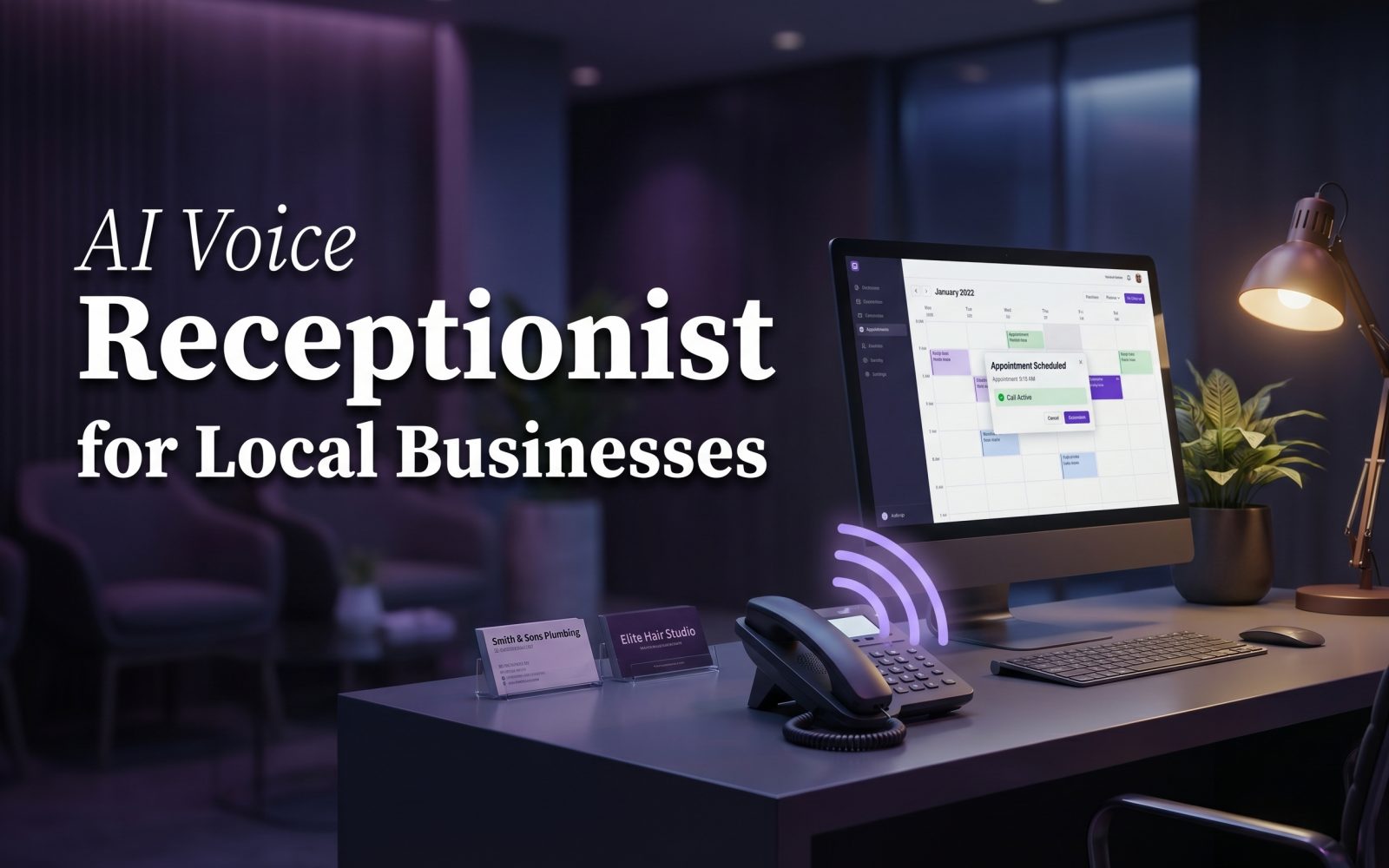
The first image is useful as an operating picture, not as a benchmark result. It shows the moment a receptionist earns its place: staff are serving people in front of them while a caller still needs acknowledgement. The saved media record identifies it as an illustration. It does not retain a model name, prompt, seed, voice, call recording, generation receipt, or task record. No model should be credited for it.
The second image shows the intended after-hours path: an incoming call becomes a captured request and then a booking or follow-up. That is the right outcome to test, but the picture itself is not evidence that a calendar event was created or that a caller accepted a time. A real evaluation needs a transcript, the selected slot, the action record, and human review of the handoff.
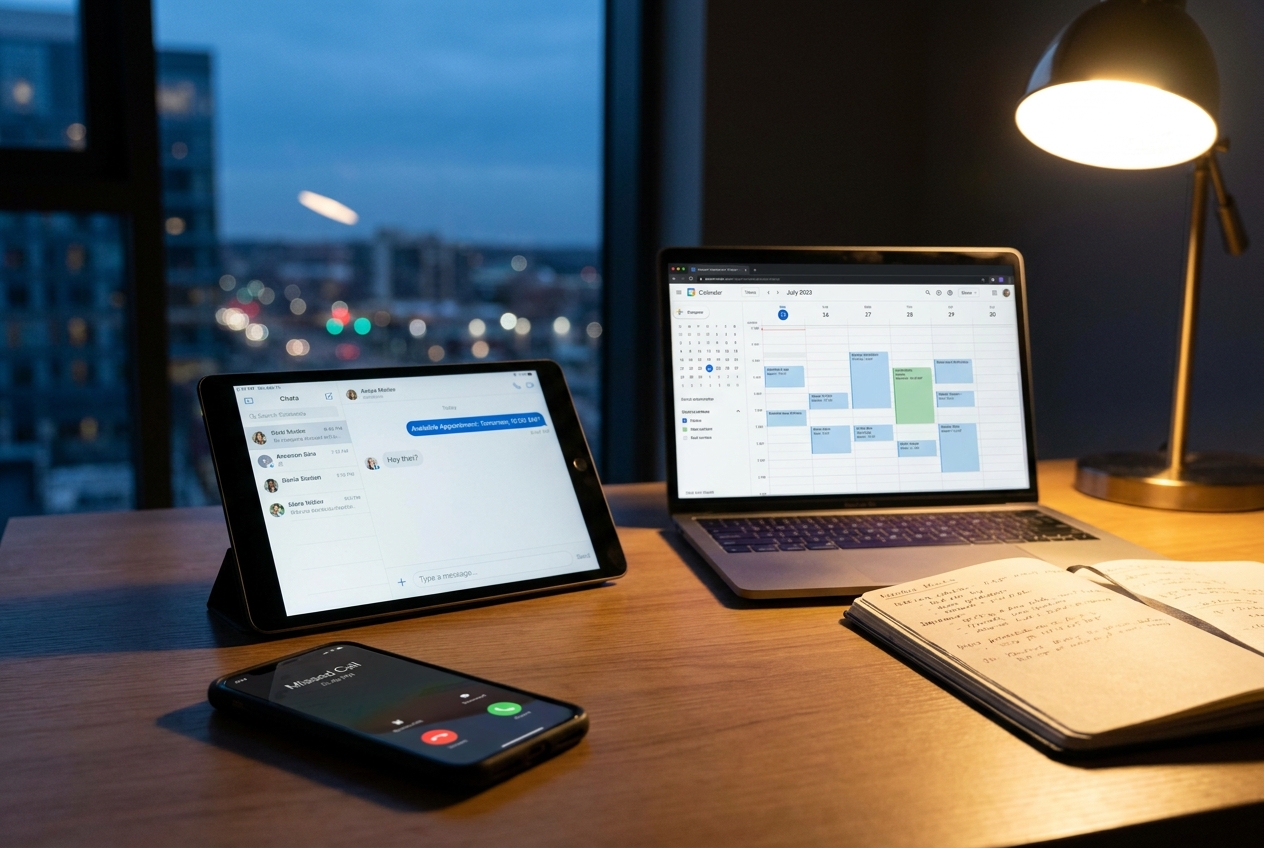
Both hosted images remain because they explain two different workflow moments: live coverage and after-hours handoff. They are the only inline media already attached to this post. Their records do not contain enough provenance to call them a fresh model comparison or to attach run statistics. Reporting that gap is more useful than guessing.
The four realtime model options behind the workflow
Wiro’s Voice Receptionist names four realtime options: GPT Realtime Mini, GPT Realtime, ElevenLabs Realtime Conversational AI, and NVIDIA PersonaPlex-Realtime. They are not interchangeable knobs. The choice affects how the team configures voice, language, silence, turn timing, and the level of control required for the call.
GPT Realtime Mini and GPT Realtime expose the same core reception controls: a selected voice, system instructions, transcription model, input and output audio format, audio rate, voice-activity threshold, and silence duration. The documented defaults are 24 kHz PCM audio, a turn threshold of 0.5, and 500 ms of silence before the agent responds. Mini defaults to gpt-4o-mini-transcribe; the larger GPT Realtime defaults to gpt-4o-transcribe. Use telephony audio formats where the phone bridge requires them, and keep the transcript model explicit so quality and speed are a deliberate trade-off.
ElevenLabs offers a different control surface. Its documented options include a voice ID, greeting, language, TTS model, turn timeout, silence auto-close, maximum duration, turn eagerness, speed, stability, similarity boost, streaming-latency optimization, and audio format. The defaults include a seven-second turn timeout, a 30-second silence close, a 600-second maximum session, normal turn eagerness, and 24 kHz PCM. That is useful when a business cares strongly about the sound and pacing of the brand voice.
PersonaPlex-Realtime exposes a text role prompt, a natural or variety voice, text temperature, audio top K, text top K, and a seed. Its documented default is a variety female voice, text temperature 0.7, audio top K 250, text top K 25, and seed 0. That makes it the option to evaluate when the team wants to test prompt-led persona control and voice style while keeping the business facts tightly scoped.
Parameters, run time, and cost on Wiro
| Model | Useful documented controls | What this post can honestly report |
|---|---|---|
| GPT Realtime Mini | Voice, transcription model, 24 kHz or 8 kHz audio, VAD threshold, silence timing | No saved run time or per-output cost for this post |
| GPT Realtime | Same reception controls, with gpt-4o-transcribe as the documented default | No saved run time or per-output cost for this post |
| ElevenLabs Realtime Conversational AI | Voice, language, greeting, turn and silence timeouts, latency setting, stability | No saved run time or per-output cost for this post |
| PersonaPlex-Realtime | Role prompt, voice family, temperature, audio and text top K, seed | No saved run time or per-output cost for this post |
The Wiro agent page says GPT Realtime Mini can deliver under 300 ms end-to-end latency in its described setup, and it bills realtime calls in 30-second buckets. That is product guidance, not a measured result from the two preserved images. The model docs reviewed for this update do not publish a fixed cost per output, and this post has no task receipts. No currency figure or elapsed time has been inferred from another run. For a real rollout, record task timing, call duration, AI usage, carrier charges, transcript quality, completed bookings, and human corrections for each model and call type.
Six smart wins for a local business
1. Cover the first ring
Use the agent when staff are already helping a customer. A short greeting and clear choice between booking, question, existing appointment, and urgent help prevents a caller from hearing an empty line.
2. Answer approved repeat questions
Opening hours, location, services, parking, and basic preparation instructions belong in an approved knowledge set. Keep those facts short and review them when the business changes.
3. Capture appointment intent
Collect the service, preferred time, contact method, and any constraint that a human needs to confirm. Do not treat an unverified request as a booked appointment.
4. Make after-hours intake useful
After hours, capture a callback request with the caller’s preferred window. For a real emergency path, route immediately to the business’s approved escalation number or instruction.
5. Produce a usable handoff
A staff member should see a concise recap: caller, intent, requested time, promised next step, and anything that needs a response. A transcript alone is not a handoff.
6. Keep the human in control
Let staff interrupt or end a call, review drafts, and correct records. The agent should reduce repetitive intake, not hide important judgment behind automation.
When to pick which model
Start with GPT Realtime Mini for a cost-aware, general local-business pilot where fast response and standard reception controls matter most. Move to GPT Realtime when the team wants the same configuration shape with the larger model’s transcription default and a higher-touch experience. Pick ElevenLabs when voice identity, greeting style, language behavior, and pacing need fine-grained attention. Test PersonaPlex when prompt-led persona control and its voice families are central to the experience.
Model choice comes after workflow design. Define the greeting, approved facts, booking policy, escalation categories, business hours, calendar permissions, transcript retention, and a human owner for every exception. Then test the same four caller scenarios across the shortlisted models. Review false bookings, interruptions, language handling, and the handoff record before taking calls live.
Related Wiro guides
For adjacent implementation work, read AI Receptionist for Missed Calls, Realtime Voice Conversation: 3 Smart Wiro Setups in 2026, and Realtime Speech to Text: 3 Smart Wiro Models in 2026.
Source notes
For provider-level implementation detail, see the OpenAI Realtime API documentation, the ElevenLabs Conversational AI documentation, and the NVIDIA PersonaPlex repository. Each source returned HTTP 200 when checked for this update.
Try it
Explore the Voice Receptionist to build a controlled first-response flow for your business line.