Mobile growth AI agents connect the work that usually breaks apart after an app release: review handling, event follow-up, and retention messaging. This test checks whether those jobs can operate as one decision loop instead of three disconnected queues.
This is not a model benchmark. The original post names no underlying model, prompt, model version, API setting, or Wiro run ID. Its two saved outputs are workflow illustrations, not reproducible model samples. That limit matters. No honest comparison can assign a generation time or a per-output Wiro cost when the source record does not contain either value.
What the mobile growth AI agents test set out to check
The test asks a practical operations question: can a team turn incoming app feedback into a better next action before the signal goes stale? A useful loop starts with evidence, labels the problem, gives it an owner, records the action, and checks whether the next release or message changed the result.
That is different from automating a single reply. A review response may help one customer, but it does not help product, marketing, or lifecycle teams unless the issue is classified and connected to the relevant release, event, or cohort. The same is true for a push notification. A send can lift an immediate metric while creating more opt-outs or complaints if it ignores recent feedback.
Apple says ratings and reviews help people decide what to download, and its guidance recommends asking at moments when users have completed a satisfying action. Apple’s ratings and reviews guidance also notes that written reviews remain visible after a ratings reset. That makes issue tracking after a release more useful than treating the rating as a one-time score.
What the two saved outputs actually show

The first output is a visual explanation of the operating model. It does not show an app dashboard, a user record, or a model response. Its useful claim is structural: feedback should influence the next launch and the next retention action. The WordPress attachment records a 1280 by 720 JPEG file, 135,633 bytes. It has no caption, embedded prompt, creator credit, model name, or generation metadata.
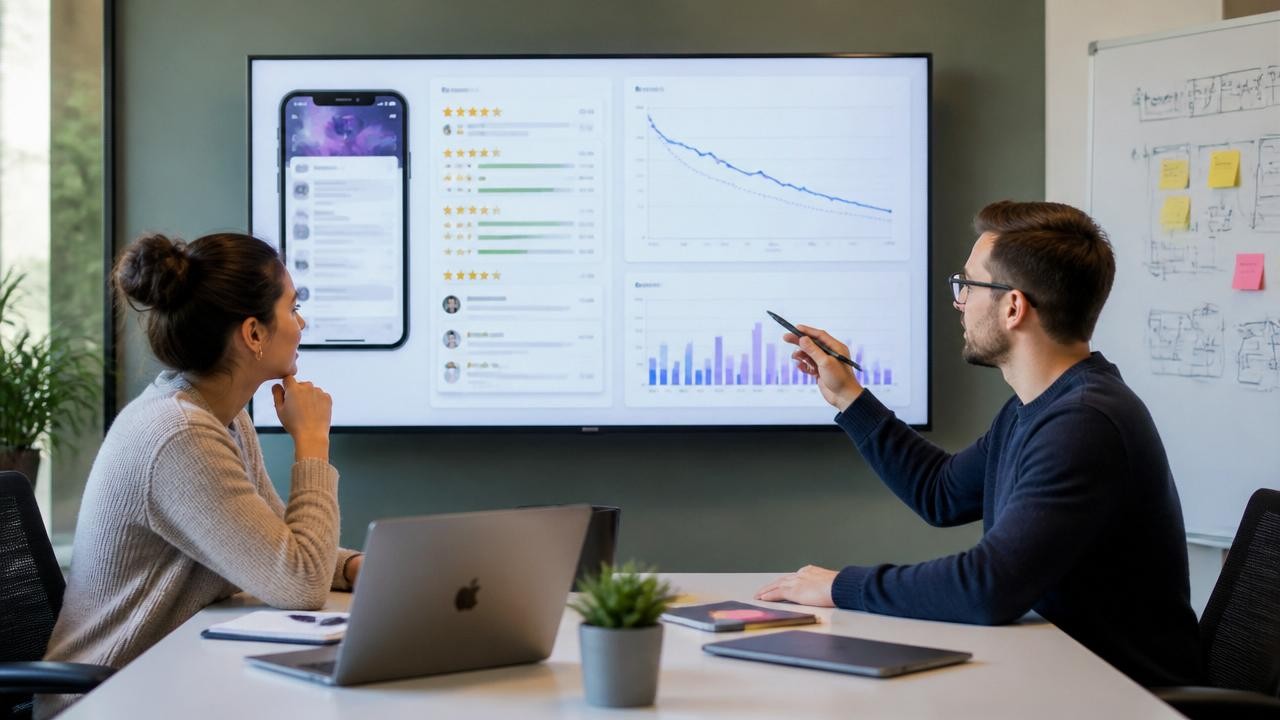
The second output narrows the same idea to feedback after a release or campaign. It suggests a short handoff: collect the signal, identify the cause, select an owner, and change the next message or product task. This file is also a 1280 by 720 JPEG. Its recorded size is 125,967 bytes. Like the first image, it has no stored prompt, model identifier, elapsed generation time, or Wiro billing record.
Parameters, run time, and cost
The only verifiable output parameters are the published file properties above: JPEG format and 1280 by 720 dimensions. No model parameters are available. The source does not identify a model owner or project, so there are no applicable Wiro model documentation pages to read for this post. No inference was run for this refresh.
| Output | Verified parameters | Run time on Wiro | Cost on Wiro |
|---|---|---|---|
| Output 1 | JPEG, 1280 x 720, 135,633 bytes | Not recorded | Not recorded |
| Output 2 | JPEG, 1280 x 720, 125,967 bytes | Not recorded | Not recorded |
Those blanks are intentional. Estimating a runtime from image dimensions or inventing a price from a generic model category would make the post less useful. A future reproducible test should save the selected Wiro model URL, version, input prompt or payload, relevant options, start and completion timestamps, output URL, and billed cost beside each asset.
Seven loops worth running
1. Review triage after a release
Collect new reviews by storefront, version, locale, rating, and issue type. Separate crash reports, account problems, feature requests, billing complaints, and praise. Route urgent support cases first. Group the rest into themes that product can inspect. Google Play exposes clustered review data and allows teams to see and reply to incoming reviews before new public submissions necessarily affect the displayed rating.
2. Release-to-review matching
Tag every review with the active app version and release window. This stops a team from blaming a new release for an old complaint. It also creates a clean question for the next review: did mentions of the target issue fall after the fix shipped?
3. Event quality checks
Compare an app event or promotion with the language of reviews that arrive afterward. Look for a mismatch between the event promise and the experience people describe. An event that produces downloads but increases complaints about onboarding, pricing, or reliability needs a product or support response, not another send.
4. Response drafting with a human owner
Use an agent path to draft a concise response from the issue category, version, and approved support policy. Keep a human owner for refunds, privacy matters, abuse, and claims that need account access. The useful metric is not reply volume. It is the time from a valid review to a correct, approved answer.
5. Retention segmentation from behavior
Build segments from observed behavior, not broad labels. A new user who stalled before activation needs a different message from a previously active subscriber who stopped after an update. Firebase Cloud Messaging supports notification and data messages as well as device, group, and topic targeting; its official documentation is a useful implementation reference for teams that send through FCM.
6. Suppression after negative signals
Pause promotional messaging for people who just reported a serious fault, requested support, or failed at a key step. The goal is not to remove them from communication forever. It is to avoid sending a cheerful campaign while the unresolved problem is still the strongest recent signal.
7. Closed-loop learning
At the end of each cycle, compare issue volume, response time, release version, push engagement, opt-outs, and return behavior. Keep the question narrow: which action changed which signal? A loop that cannot answer that question is a reporting ritual, not a growth system.
Which Wiro agent path to pick
Choose App Review Support when the immediate bottleneck is sorting reviews, drafting replies, and escalating product or support issues. Choose App Event Manager when launches and store events need a tighter brief-to-execution handoff. Choose Push Notification Manager when the team already has segments and needs disciplined timing, copy review, and follow-up measurement.
Use more than one path only after the handoff is explicit. Review triage should produce categories that event planning can use. Event outcomes should shape suppression and retention logic. Otherwise, adding agents only creates more alerts.
Related reading
- AI Agents for App Reviews and Mobile Support
- AI Agents for Push Notifications and App Events
- AI Agents for Customer Winback Campaigns
Start with the loop that loses the most context today. Save the inputs, owner, decision, and outcome for every run. That record makes the next action faster and makes the system auditable when a release or campaign misses the mark.