Seedance 2.0 vs Seedance V1 Pro Fast comes down to a useful trade-off: richer control and a wider feature set on one side, and much shorter turnaround on the other. This five-prompt test used the same vertical text-to-video brief for both models so the clips could expose differences in motion, material detail, camera instruction, style control, and readable text.
Models in this Seedance 2.0 vs Seedance V1 Pro Fast test
Seedance 2.0 accepts text prompts, optional first and last frames, one to nine reference images, and reference audio in supported combinations. Its Wiro controls include 480p through 4K, 4 to 15 seconds, several aspect ratios, synchronized generated audio, prompt enhancement, watermark, and seed. That makes it the more flexible option when a shot needs reference-driven direction or sound.
Seedance V1 Pro Fast handles text-to-video and image-to-video at 480p, 720p, or 1080p. It offers 5- or 10-second clips, aspect-ratio selection, a seed, watermark control, and a fixed-camera switch. It has fewer controls in this comparison, but that simpler path is relevant when a team needs quick iterations rather than a long setup.
For the maker context, see ByteDance’s official Seed site. The linked page returned HTTP 200 when checked for this update.
Test setup: one fair vertical brief per scene
Each model received the same five text prompts. Every run used 480p, 9:16, five seconds, watermark off, and one output per prompt. Audio was off. The clips are text-to-video tests, so no source image or reference image was supplied. The aim was not to declare a permanent winner from five generations. It was to see how each model behaves when a prompt asks for several things at once: a subject action, a camera move, a lighting condition, a material, and sometimes text.
The settings matter. Seedance 2.0 supports higher resolutions and more duration choices, but those options were deliberately not used here. Seedance V1 Pro Fast also offers a fixed-camera control, but it was left off because the prompts request movement. Keeping the short, vertical format equal makes the elapsed-time comparison more useful for a social clip workflow.
Five prompts, ten outputs
1. Pottery studio close-up: hands, clay, and a push-in
Prompt: Vertical handheld documentary shot inside a busy pottery studio. A ceramic vase spins on a wheel. Hands shape wet clay. Camera slowly pushes in. Tiny droplets of water on fingers. Warm window light. Natural motion. Subtle 35mm film grain.
| Seedance 2.0 | Seedance V1 Pro Fast |
|---|---|
This is a close-detail test. The useful checks are whether fingers stay coherent while the vase rotates, whether wet highlights crawl across the clay, and whether the push-in feels intentional. In this pair, Seedance 2.0 looked cleaner around the hands and the wet-clay highlights. That does not make it a universal hands winner, but it is the better of these two outputs for a detail-led documentary shot.
2. Glass perfume teaser: reflections and the word LUCENT
Prompt: Vertical studio product teaser. A translucent blue glass perfume bottle floats above black water. Ripples react to the bottle movement. Slow orbit camera. Soft neon rim light. The label shows clear text LUCENT in clean capital letters. Crisp reflections, realistic materials.
| Seedance 2.0 | Seedance V1 Pro Fast |
|---|---|
Product work raises the bar because glass, liquid, orbit motion, and label text can all fail independently. The Seedance 2.0 output held the bottle and label more convincingly in this run. Neither result should be treated as final packaging artwork without checking every frame, but the clip shows why explicit text remains a stress test rather than a promise.
3. Paper astronauts: deliberate stop motion, not flicker
Prompt: Vertical stop motion paper cutout animation. Paper astronauts assemble a cardboard rocket on a wooden desk. Visible paper fibers and hand cut edges. Overhead camera then gentle tilt. Choppy deliberate motion, playful. Warm desk lamp light, shallow depth of field.
| Seedance 2.0 | Seedance V1 Pro Fast |
|---|---|
This prompt separates designed stutter from accidental instability. Paper fibers, cut edges, and the desk should persist while the animation advances in steps. Seedance V1 Pro Fast produced the stronger result here. Its paper-craft look and deliberate motion read more like a chosen technique, which makes it the sensible first try for a playful stylized social clip.
4. Hummingbird macro: rapid wings and shallow depth of field
Prompt: Vertical wildlife macro shot. A hummingbird hovers near bright red flowers. Wings flutter in slow motion. Tiny pollen dust in the air. Camera tracks sideways smoothly. Natural morning sunlight, creamy bokeh background, high detail feathers.
| Seedance 2.0 | Seedance V1 Pro Fast |
|---|---|
The hard part is keeping a tiny fast-moving animal distinct from the blurred background. Look for feather edges that do not melt and flowers that do not change shape during the track. Seedance V1 Pro Fast was stronger on this example. It is a good reminder to judge the actual clip, not the model name, when a prompt depends on fine motion.
5. Neon rain alley: the combined stress test
Prompt: Vertical cyberpunk alley in heavy rain at night. Neon signs reflect on puddles. A drone camera flies forward then banks left around a corner. Steam vents. A sign shows clear text NIGHT NOODLES. Realistic water splashes, cinematic contrast, 35mm look.
| Seedance 2.0 | Seedance V1 Pro Fast |
|---|---|
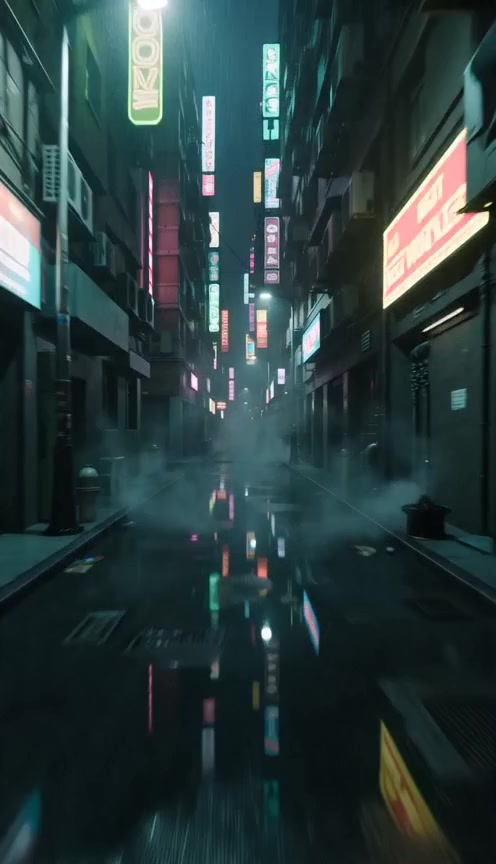
Rain creates a large number of moving reflections and occlusions. Adding a drone-like bank and requested lettering makes it the most demanding prompt in the set. Seedance 2.0 looked cleaner in this paired output, especially in the overall alley frame and sign treatment. It still deserves a frame-by-frame review before any production use.
Run time and cost per output on Wiro
The task-detail responses recorded provider elapsed time, not end-to-end wall-clock time. Queue time, upload time, and post-processing around the provider may differ. Seedance V1 Pro Fast returned sooner in all five tested runs: 25, 29, 55, 25, and 56 seconds. Seedance 2.0 recorded 90, 90, 190, 149, and 112 seconds for the same prompts.
| Prompt | Seedance 2.0 elapsed | V1 Pro Fast elapsed |
|---|---|---|
| Pottery | 90 s | 25 s |
| Perfume | 90 s | 29 s |
| Paper craft | 190 s | 55 s |
| Hummingbird | 149 s | 25 s |
| Neon alley | 112 s | 56 s |
No per-output cost was retained in the five original completed task records, and the current model documentation lists controls and capabilities rather than a fixed price schedule. For that reason, this update does not invent a dollar figure or infer one from elapsed seconds. Check the Wiro run detail at the time of generation for the actual charge; resolution, duration, and input mode can change it.
Which model should you pick?
Pick Seedance V1 Pro Fast when iteration speed matters most. It won the turnaround comparison in every run and made the stronger paper-craft and hummingbird clips. It is a practical choice for testing variants, quick vertical concepts, and workflows where several generations are needed before choosing a take.
Pick Seedance 2.0 when the project needs more control or the extra options matter: longer duration choices, up to 4K, generated audio, prompt enhancement, reference images, or first-and-last-frame direction. In this set, it also produced the preferred pottery, glass-product, and neon-alley outputs. The slower provider times are the trade-off.
For adjacent comparisons, read LTX-Video vs Kling vs Seedance, Seedance V1 Pro Fast vs Wan 2.6, and Best Cinematic Image-to-Video Models. Run the same prompt through Seedance 2.0 and Seedance V1 Pro Fast, then choose from the clip rather than a single benchmark label.