
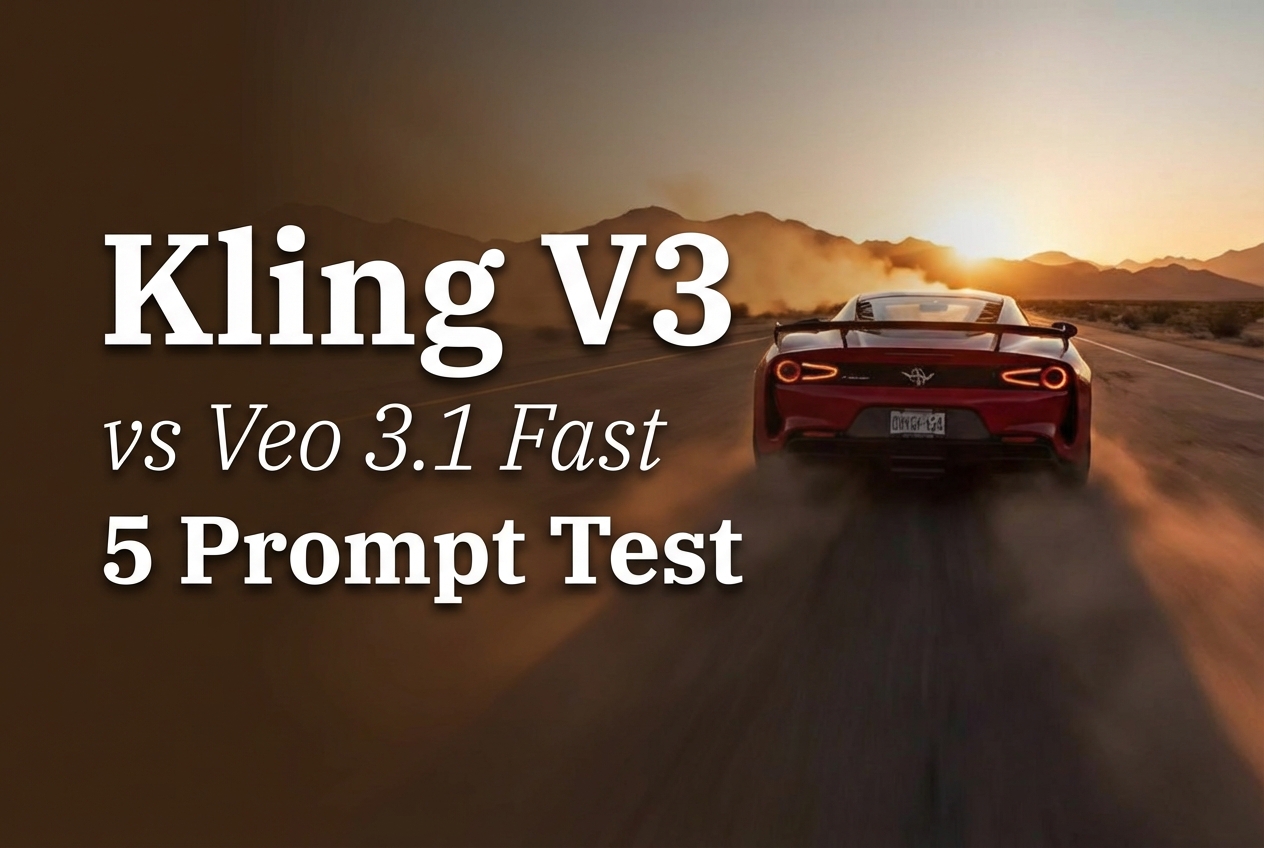
Kling V3 vs Veo 3.1 Fast comes down to a practical question: which model is the better fit when a short prompt has to carry camera direction, subject behavior, material detail, and a recognizable visual style? This five-prompt test keeps the brief fixed and compares the resulting clips rather than treating a single attractive frame as a verdict. Both runs used text-to-video, 16:9 framing, a six-second target, and audio off.
Kling V3 on Wiro
Veo 3.1 Fast on Wiro
What the Kling V3 vs Veo 3.1 Fast test checks
The set deliberately mixes conditions that expose different failure modes. The alley scene asks for forward handheld movement, crowd density, steam, reflections, and a readable sign. The bottle asks for product geometry, controlled reflections, and an orbit. The chase tests fast motion and spatial continuity. The hummingbird tests a small moving subject and a shallow focus plane. The stop-motion piece asks for a non-photoreal material, visible fingerprints, and a change in camera angle.
Kling V3 was run in its standard mode. Its Wiro controls include 5, 10, and 15 second duration options, 16:9, 9:16, and 1:1 ratios, optional sound, and an optional multi-shot mode. Veo 3.1 Fast was run at 720p with a 16:9 aspect ratio and a six-second duration. Its Wiro controls also include 1080p and 4K selections, negative prompting, a seed field, and first- and last-frame inputs. No reference frames, negative prompt, seed, sound, or multi-shot setting was used here, so the comparison stays centered on text prompting.
Google describes Veo as a model built around prompt adherence, realism, physics, and native audio. Kling’s official site presents its video line as a creative video system. Those claims are useful context, not proof of a winner. The clips below are the evidence for this small, repeatable set: Google DeepMind’s Veo page and Kling AI’s official site.
Results from the five prompts
1. Rainy street food alley: movement, atmosphere, and text
Prompt: Handheld documentary shot in a rainy night street food alley in Seoul. Neon reflections on wet pavement. Steam from grills. Sign with clear text RAMEN. Camera moves forward through the crowd, shallow depth of field, 35mm look.
This is the densest scene in the set. Kling V3 leans into the cinematic brief: wet pavement, steam, and shallow focus carry much of the mood. Veo 3.1 Fast returns a cleaner forward-moving scene, which makes it easier to inspect the crowd and storefront layout. The requested sign is a stress test, not a certification of exact text. Treat generated signage as art direction unless the final frame has been checked letter by letter.
| Kling V3 | Veo 3.1 Fast |
|---|---|
2. Studio product orbit: geometry and controlled light
Prompt: Studio tabletop product video of a matte black water bottle on a concrete pedestal. Softbox lighting. Slow orbit camera move. Label text SPARK WATER. Clean beige background, realistic reflections.
Product shots punish small geometry changes. A bottle that changes width, label placement, or highlight behavior during an orbit is hard to use in an ad. Both outputs aim for a restrained studio look. Kling V3 favors a more stylized sense of light, while Veo 3.1 Fast gives the scene a tidier commercial baseline. Neither output should be used as proof that a brand label is accurate. For production work, add reference imagery and inspect the whole clip before cutting it into a campaign.
| Kling V3 | Veo 3.1 Fast |
|---|---|
3. Desert highway chase: speed and physical continuity
Prompt: Cinematic car chase on a desert highway at sunset. Low angle tracking shot close behind a red sports car. Dust trails, heat haze, fast motion, smooth camera, realistic physics.
This prompt asks the models to reconcile two competing instructions: fast action and a smooth tracking camera. Kling V3 delivers a stronger style-first chase feeling, with dust and golden light doing important visual work. Veo 3.1 Fast keeps the basic scene more orderly in this set. Watch the road edges, wheel behavior, and the relationship between the car and its dust trail. Those details matter more than one appealing still when the goal is a believable moving shot.
| Kling V3 | Veo 3.1 Fast |
|---|---|
4. Macro hummingbird: small-subject motion
Prompt: Macro nature shot of a hummingbird hovering and drinking from a red flower. Super slow motion wing flaps, crisp focus on the eye, soft bokeh background, natural light.
A tiny bird, a flower, rapid wing movement, and macro focus leave little room for drift. Both clips show why prompt language should name the focal point. The eye is the useful inspection target, while the flower and bokeh reveal whether the depth-of-field request holds together. The prompt also requests super slow motion, but a generated clip should not be assumed to follow a measured frame-rate interpretation. It is an aesthetic instruction here, not a physics measurement.
| Kling V3 | Veo 3.1 Fast |
|---|---|
5. Stop-motion robot build: style control
Prompt: Stop motion style clay animation. Small robot builds a tiny cardboard city on a desk. Visible fingerprints in clay. Overhead camera then tilt down, warm lamp light, playful motion.
This final test is less about photorealism and more about whether the output respects a handmade material language. Kling V3 responds well to the request for a style-heavy scene. Veo 3.1 Fast maintains a clear, readable setup and gives the action a clean presentation. The difficult instruction is the camera change from overhead to tilt-down. That transition deserves a full-clip review because it is where a model can reinterpret the scene rather than simply move through it.
| Kling V3 | Veo 3.1 Fast |
|---|---|
Run time and cost notes
The task elapsed times below came from the original run logs. They are provider task times, not end-to-end wall-clock measurements. Queue time, upload time, retries, and download time are not included. Veo 3.1 Fast finished sooner on every prompt in this set, from 53 to 78 seconds, while Kling V3 took 105 to 124 seconds. That is useful for choosing an iteration model, but it does not prove the same gap for every region, resolution, prompt, or traffic level.
| Prompt | Kling V3 elapsed | Veo 3.1 Fast elapsed |
|---|---|---|
| Rainy alley | 114 seconds | 78 seconds |
| Product orbit | 105 seconds | 53 seconds |
| Highway chase | 114 seconds | 54 seconds |
| Hummingbird | 114 seconds | 76 seconds |
| Stop-motion robot | 124 seconds | 76 seconds |
No cost per output is stated in the model documentation used for this update, and the available historical run-log summary records elapsed time rather than a billable amount. A number would be invented, so none is presented here. Check the active Wiro run form before ordering a production batch, especially when switching duration, resolution, audio, or reference-image settings.
Which model to pick
Pick Veo 3.1 Fast when turnaround is the first constraint. It completed all five historical tasks faster, and its controls make it a sensible starting point for rapid text-to-video drafts, then for runs that need negative prompts, seeds, or reference-frame control. Pick Kling V3 when a prompt depends on an overt cinematic or handmade visual treatment and there is room for a longer task. Its standard, pro, and 4K modes plus multi-shot options make it worth testing when the look needs more than a clean baseline.
Neither model replaces review. Readable packaging, small animals, fast vehicles, and camera transitions are exactly where a six-second clip can look convincing until playback exposes a mismatch. Run a short A/B pair with the real prompt, retain the stronger motion and subject consistency, and only then scale the job.
Related video tests
- LTX-Video vs Kling vs Seedance: 5 Text-to-Video Tests
- Kling V3 Omni: 3 Sound-On Text-to-Video Tests
- Veo 3.1 vs Sora 2 Pro
Try the same prompts
Use the clips as a starting point, then change one variable at a time: duration, resolution, sound, reference frames, or camera language. Run the pair on Kling V3 and Veo 3.1 Fast to decide from the full motion, not a thumbnail.